Are you in debt with your garden? A post at Garden Wise Guy recently, got me thinking about how often I see gardens with plants planted in the wrong places. Like bad debt, these plants get out of control, causing damage and sapping your energy. The result is usually a completely discouraged gardener.
Decide how in debt you are by asking yourself these questions:
Get out of debt, and both you and your plant/garden will be a lot happier for it.
Decide how in debt you are by asking yourself these questions:
- Are you struggling to keep a plant/your garden/lawn under control - as fast as you trim it, its grown back already?
- Is a tree or plant getting bigger by the day, and will soon be causing damage to walls, drains, paths etc. but will cost too much to remove?
- Are you continually having to cut back plants that want to get bigger than the space allows?
- Have you got thorny plants too close to a path, that constantly need cutting back to prevent injury?
- Are you feeling overwhelmed by the amount of work needed in your garden?
If you answered yes to most of these questions, then chances are, youre in debt with your garden, and probably see your garden as a chore.
A garden is a lot like money - if planned wisely, it can grow into something of great value. But unfortunately like most of us with bad money habits, we dont invest our plants in the right place. Sometimes the problem becomes so big that we find ourselves in a hole that we cant get out of.
Continuing the financial analogy, the best way to deal with these problems is to:
A garden is a lot like money - if planned wisely, it can grow into something of great value. But unfortunately like most of us with bad money habits, we dont invest our plants in the right place. Sometimes the problem becomes so big that we find ourselves in a hole that we cant get out of.
Continuing the financial analogy, the best way to deal with these problems is to:
- Start with the smallest thing you can manage - get that under control, and it will give you energy for the bigger stuff.
- Identify potential problems early, and get a plan into place to deal with them.
Obviously, prevention is better than cure. Read up, or ask your local nursery about the plant you are about to plant. Find out how big it gets, or what its roots will do in a few years time.
Rather than continually having to trim it back, plant something that will get to the height/size that you want it to.
If you have huge areas of lawn that require constant maintenance, reduce your lawn size, or even let an area of it grow wild and plant some wild flowers into it.
The most common problem plants that I see are Fig trees, Palm Trees, Wild Bananas, and Pandanus. These all start off quite innocently small and attractive, but get out of hand so quickly. Kikuyu grass can also be a nightmare to try and keep under control.
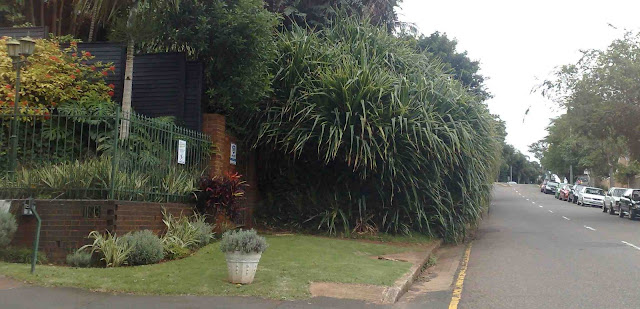
The Pandanus in this photo started off as a small spiralling little plant that is now threatening to move across the road. (You cant see him, but on the other side of the plant is a gardener trying his best to cut it back with a small bush knife!)
Rather than continually having to trim it back, plant something that will get to the height/size that you want it to.
If you have huge areas of lawn that require constant maintenance, reduce your lawn size, or even let an area of it grow wild and plant some wild flowers into it.
The most common problem plants that I see are Fig trees, Palm Trees, Wild Bananas, and Pandanus. These all start off quite innocently small and attractive, but get out of hand so quickly. Kikuyu grass can also be a nightmare to try and keep under control.
The Pandanus in this photo started off as a small spiralling little plant that is now threatening to move across the road. (You cant see him, but on the other side of the plant is a gardener trying his best to cut it back with a small bush knife!)
Get out of debt, and both you and your plant/garden will be a lot happier for it.